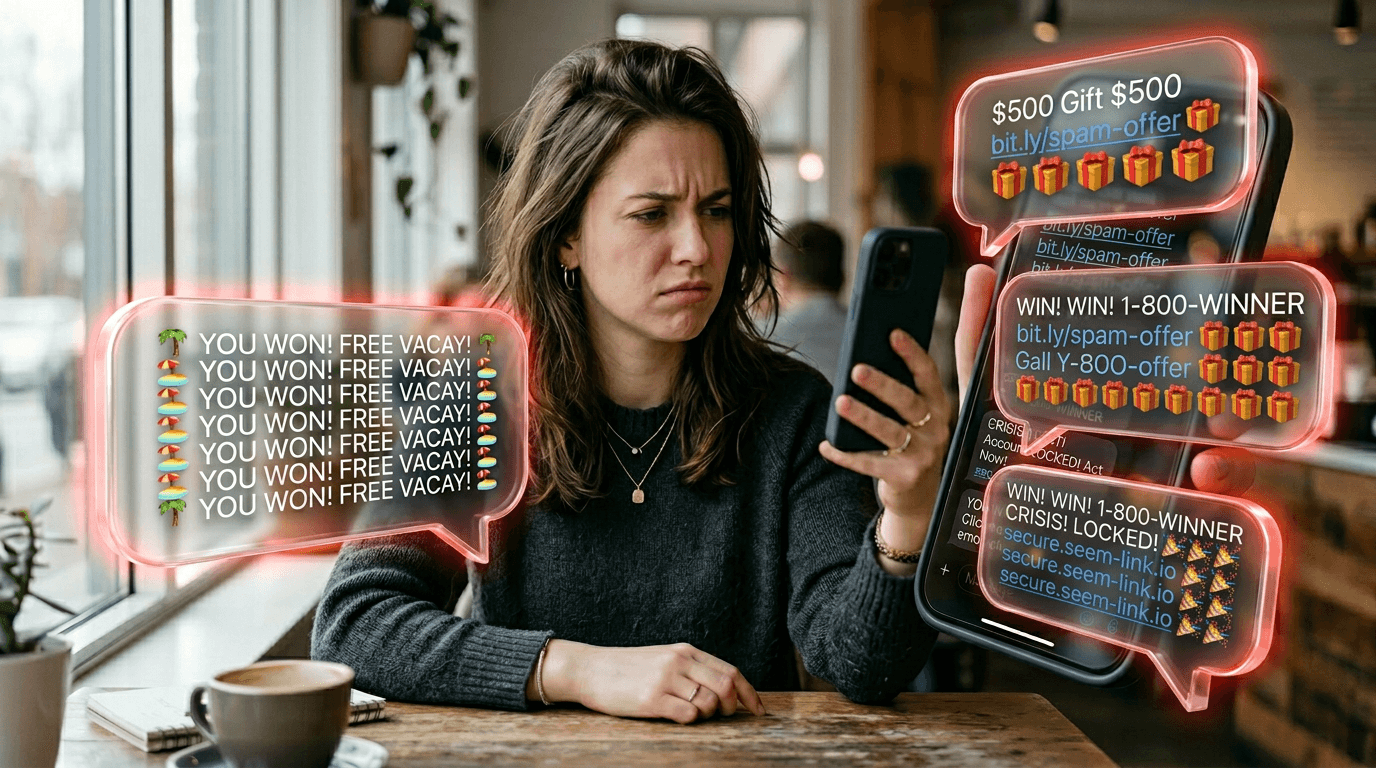
Divya managed a 180-member group for urban gardening enthusiasts in Bangalore. In three months, she watched eleven members leave without explanation. She checked the exit timestamps and noticed a pattern: every departure came within 24 hours of a spam wave, someone posting a link to cheap plant pots, someone else forwarding a "10 miracle plants that cure everything" article, a third person sharing an unrelated religious message.
She'd been watching the people leaving instead of the content that drove them away.
Spam is the single largest reason high-quality members leave WhatsApp groups silently. They don't complain or give you a chance to fix it; they leave. And the members most likely to go are the ones you most want to keep: the engaged, thoughtful contributors who have other options for their attention.
The Six Types of WhatsApp Spam
Treating all spam as one thing leads to blunt moderation that sometimes removes content with some value. Sort it first, then decide how hard to respond.
Promotional spam: Direct pitches for products, services, affiliate links, MLM schemes, or business advertisements. This is the most common type in professional and interest-based groups. Spammers often frame it as "sharing something useful."
Forwarded message spam: Content forwarded from other WhatsApp groups, "breaking news," viral videos, motivational quotes, jokes. The forwarded label shows when a message has been forwarded more than five times. Heavy forwarders often send 5-10 pieces of forwarded content per day.
Chain messages: Messages with instructions to "forward this to 10 people or something bad will happen" or "forward to get a WhatsApp feature." These are old internet chain letter mechanics applied to messaging.
Off-topic spam: Content that's fine in general but has nothing to do with your group's purpose. Someone in an accounting group posting their child's birthday party photos, or sharing a recipe in a real estate group.
Fake news and misinformation: Unverified health claims, political propaganda, fabricated screenshots. This type causes the most harm to group culture because it forces members to either correct it (creating conflict) or tolerate false information.
Repetitive posting: Legitimate content posted over and over. Someone who posts the same job opening every three days, or who re-shares the same article with slightly different framing.
How Spammers Get In
The most common entry point is an open group invite link. If you've ever shared your group's invite link publicly, in a Facebook post, on a website, in an email newsletter, that link can be picked up and used by anyone, including bots and people who have no genuine interest in your group's purpose.
The second entry point is member referrals gone wrong. A real member adds someone they know who turns out to be a serial spammer. The referring member didn't know, so don't blame them, but it's still an entry point.
The third is opportunistic joining. Someone joins a large, active group for the audience size, not the topic. A 200-person group represents 200 potential customers for whatever they're selling. They'll participate just enough to seem legitimate, then shift to promotional content.
Prevention: Five Measures That Work Before Spam Appears
1. Disable the group invite link and vet new members manually. This is the most effective single step for groups where quality matters more than growth speed. Anyone who wants to join has to ask an admin. You have a brief conversation, confirm they're a fit, then add them directly. This creates friction that serious spammers won't bother with.
2. Set the group to admin-only additions. In group settings, restrict who can add members to admins only. This prevents existing members from adding their contacts without vetting.
3. Ask a screening question. Before adding someone, ask them: "What's your specific interest in [group topic]?" A person who wants to spam your group won't have a coherent answer. This takes 30 seconds per potential member and filters out most bad actors.
4. Use disappearing messages for the right reasons. Disappearing messages (set to 24 hours, 7 days, or 90 days) don't prevent spam, but they reduce the archive problem. Spammy content doesn't persist indefinitely in the chat history that new members see when they join.
5. Set clear expectations on day one. Your welcome message and pinned rules should explicitly state what counts as spam and what happens to members who post it. This doesn't stop deliberate spammers, but it significantly reduces accidental spam from genuine members who didn't know the rules.
Dealing With Spam When It Happens
When spam appears, the sequence matters:
Delete the content immediately. Don't leave it visible while you decide what to do. Every minute it stays up is a minute your members are seeing content that degrades their experience.
Check the member's history. Is this their first violation? Have they posted other borderline content? Is this clearly deliberate or possibly an honest mistake?
First offense, genuine member: Private DM. "Hey [Name], I removed your post, promotional links aren't allowed in the group. Check the pinned rules for what works here. No hard feelings, just keeping the group clean."
First offense, suspicious member: Check if their WhatsApp profile looks like a real person. Look at their previous posts. If it feels off, remove them. You don't owe a spammer the benefit of the doubt.
Repeat offense: Remove from the group without a second warning. You already gave them one.
Never address spam publicly in the group. Don't post "someone just shared spam, please don't do that." It's inefficient, it draws attention to the content you're trying to delete, and it subtly signals to the group that violations aren't handled swiftly.
The Cost of Ignoring Spam
Admins sometimes let spam slide because confrontation is uncomfortable or because removing a member feels harsh. That decision has a cost.
Members who leave a WhatsApp group silently, without saying why, mostly leave because the content quality dropped. They stop engaging first, then go, and each one takes their potential contributions with them.
Once a group develops a reputation as "spammy," it's very difficult to recover. The quality members who left don't come back. The members who stay are disproportionately comfortable with spam, which makes the problem worse over time. The group settles into a lower-quality equilibrium.
Divya deleted 40 messages across three weeks, removed four members, and revised the group rules to be explicit about promotional content. The exits stopped. Two members who had left rejoined when a mutual friend told them the group had improved.
When Manual Moderation Isn't Enough
For groups with high volume and active membership, spam appears faster than a human admin can realistically catch it, especially across multiple time zones or overnight. A forwarded message that arrives at 2am sits in the chat for hours before anyone notices.
Automated moderation can catch forwarded messages (WhatsApp marks them as such), flag known spam patterns, and alert admins to content that needs human review. It handles the obvious cases instantly so admins can spend their judgment on the nuanced ones.
GroupMateAI is coming soon
Join the waitlist to get early access to AI-powered moderation for your WhatsApp or Telegram group.
Join the waitlist